One of my Navajo friends, Ernest, suggested I talk to his father, a bonafide Diné elder. So, he took me to his father, who did not understand a word of English. And of course, my Navajo was so faltering that I had to have an interpreter. In Navajo, Ernest said to his father, ‘This man wants to put our story down in one of these.’ Then he pointed to a book I had carried with me. The old man picked up the book, put it to his ear and hesitated for a minute. Then he looked me in the eye, and said, ‘I don't hear anything.’”
The son of immigrants, Paul grew up in industrial Pittsburgh. He remembers gathering on the sidewalk, on the steps of terraces, where the men would tell stories of the old country. Most couldn’t read or write but they could tell a fantastic story. “I was listening and I was making this discovery,” he says. “I realized these guys were poets. We were living an oral tradition.”
I ask Paul how he came to find the Diné Bahane’, or maybe rather how the Diné Bahane’ found him. He tells me, “It’s a long story. In a way, it's a story of my life.” He fell in love with John Milton as an undergraduate at the University of Pittsburgh in 1955. “That's when I first read it...and I stayed with it,” he refers to his first encounter with the epic poem, Paradise Lost. He was a student of English literature–late medieval and Renaissance.
By 1964, he had graduated from the role of “student” to “professor,” teaching a Milton seminar at Allegheny College, just 90 miles north of Pittsburgh. But that was not the end of the road for his academic inquiry. A “life-changing experience” was waiting, miles ahead.
In August of that year, he took a trip to California, headed for Glacier National Park. On the way, he found himself at the Museum of the Plains Indians in Browning, Montana. What had been planned as a quick post-lunch drop-in turned into a three-hour tour. Paul says “I was just so taken by the whole thing. Allegedly, this was the first museum where the Native Americans, themselves, created the exhibits. They gave me a brand new picture of so-called ‘Indians.’ I was so taken by it because they were humanized, and it occurred to me: ‘Hey, maybe they have a great epic too.’”
Paul returned to Pennsylvania and began his research. Every Tuesday afternoon you could find him in the folklore collection at the Cleveland Public Museum. He was searching for the great epic he imagined must exist, and he did “enough research to confirm that there was a good possibility.”
In 1972, he took a sabbatical and moved to Albuquerque, as Visiting Fellow at the University of New Mexico. He was seeking an ‘American Indian epic’ akin to the grandeur of Milton’s Paradise Lost.
Once he discovered their extant and viable oral tradition, he turned his attention to the Diné. He took Navajo courses. Eventually, he got his hands on the 1847 work, Navajo Legends, authored by Washington Matthews. Inside that book, Paul uncovered a raw version of the Diné Bahaneʼ. It was like unearthing an unspeakable treasure. He spent the next 10 years working on a translation that was, finally, published by the University of New Mexico Press in 1983.
“It was a long process, the whole thing,’ Paul says, “And it was a life-changing experience–beginning with just an accidental visit to a small modest museum in an out-of-the-way Montana town.” Paul returned to Milton’s Paradise Lost at Allegheny, teaching the seminar, as a professor, for 30 years. “So I knew the poem well,” he admits. “But just for fun, about five years ago, I decided to go back and read it again. I just poured over this thing, looking at it from an entirely different point of view.
That’s when I realized that Adam and Eve aren't full-grown, mature men and women. They're kids! And that's the beauty of the whole thing.
Adam wakes up. He looks around and he sees the world. He’s got this great ‘gee-whizz’ attitude about everything and then he gets lonely. And so God makes Eve out of his rib and they fall in love immediately. It's a love story. It's a great love story. That's why I like it.”
I am surprised to learn that John Milton didn’t write all of Paradise Lost. Some of it he recited. Paul explains that, after its completion, Milton was an old blind man. A Puritan follower of Oliver Cromwell, the poet had been exiled to a little cottage outside London. “He narrated pieces of the work to just about anybody who came by for a visit, but especially to one of his daughters.”
So Paradise Lost was originally an oral composition. Paul continues by pointing out: “Of course, the Old Testamentitself is based on oral tradition, so there's that kind of link. This is what really excited me. Once I started working with the Navajos, I got all kinds of insights about the relationship between oral tradition and print. What I did, to some degree, was to simulate what the poet Homer did. He listened to all these stories, and then he was the one who put them into print.”
.PNG)
I, like Paul, am inspired by the storytellers who came before us, especially those who were inspired by the storytellers who came before them. I celebrate those who recognized a sacred thread running through even the most mundane, everyday folktale. Paul tells me about Albert Lord, who wrote a book called The Singer of Tales: “He had worked with a folklorist between World War I and World War II. They were recording singers in the Balkans, in Serbo-Croatia. Gradually, they came to realize what they were hearing. The songs were poetic passages – almost straight out of Homer. This oral tradition had survived among these itinerant singers in Serbia and Croatia. Great story.”
This story makes me curious. I want to know what is lost and, possibly, what's gained when the oral tradition–the songs–gets written down. I am still thinking about Diné Bahane’, of course, and (now also) Paradise Lost. But beyond the works, I wonder about Paul’s memories. This interview – taking down Paul’s words – feels like a tiny contribution to his legacy. I ask: “What happens when we write the story down? Take for instance the story of Paul Zolbrod. What is to be gained from this? And what is to be lost? What is sacrificed when things that were spoken become written?”
Paul is thoughtful when he replies, “My first impulse is to say that learning about the oral tradition doesn't tell me about loss. It tells me about gain. Every culture has a past. Every culture...” He interrupts himself to tell me another story.
“After I'd spent all those years [researching for Diné Bahane’] I was close to submitting the manuscript to a publisher. But before I put it in print, I wanted to get official permission from the tribe. A Navajo woman who had tried to do this before warned me: ‘‘Don’t take it to Window Rock’ – the capital, the Navajo equivalent of Washington, D.C. She told me to find a different way.
One of my Navajo friends, Ernest, suggested I talk to his father, a bonafide Diné elder. So, he took me to his father, who did not understand a word of English. And of course, my Navajo was so faltering that I had to have an interpreter. In Navajo, Ernest said to his father, ‘This man wants to put our story down in one of these.’ Then he pointed to a book I had carried with me. The old man picked up the book, put it to his ear and hesitated for a minute.
Then he looked me in the eye, and said,
‘I don't hear anything.’”
“After we talked for a while more, he said, ‘Come back in six months. I'll give word of what you're doing, and we'll see what they say.’ Now, the manuscript was finished by then. I resolved that if they said, ‘Don't do it,’ I wouldn't. So I went back and here’s what he said:
‘Well, we're not happy that this is being put down in words, because words on the page don't say anything. But our young people are getting indifferent to all this. And this is a way of preserving it.’
...And I think that's the best statement I can make about the cultural transition from oral tradition to written tradition,” Paul concludes.
I agree with him. This story says it all. A part of me wants to end the interview right here. …But I have to continue because Paul makes more valuable statements, contrasting oral traditions with written literature:
“For instance, in literary study, there's one authoritative version,” he says, “But in oral traditions, there’s no definitive version of a story. He tells me how the many versions he found of the Diné Bahane’ made it challenging to decide on his published translation.
“One of the problems,” he admits, “was picking and choosing from all the different variants. I remember showing my book to a feisty young Navajo poet. He read it and I said, ‘What did you think?’
He made a sour face and said, ‘Well, you know that song by Johnny Cash about Cadillacs? It’s like that. You’re taking one part from here and one part from there, and you're putting together this...this machine.’ Then he hesitated before he grinned and said, ‘But you know what? It's pretty good.’
The relationship between oral tradition and written work is important, but we still don't understand it. And now we live in a post-literary age” Paul asserts. “People don't read books and I think they are less informed. They may be less entertained too. It's a complicated matter. If I had another lifetime, I would probably study how people preserve their past. People want to preserve their past. That’s where their identity is.”
As Paul is speaking, I keep thinking about how there is something sacred in sound. The oral storytelling tradition has a different kind of soul. We want to preserve the past, yet once the words are written on paper something is lost in two-dimensionality. It strikes me as similar to the difference between a person and a person’s photograph.
I get a little tongue-tied explaining this to Paul.
I feel like I have to add a defense for literature…“But with a written piece, there’s also this broadening of the imagination, right?” I am musing out lout…“Whereby each reader gets to apply their voice–their imagination–to the story. They inject their own soul into the words. And then it becomes more expansive than those limited two dimensions.”
To my relief, he volleys back, “That’s right.” Then he adds more about the value of imagination: “When I started to read written versions of the Diné Bahane’, there was no illustrated record of it – none that I could understand. This was challenging. I had to imagine it in my mind – these insect people deep down in the earth. At first, I just couldn't do it. I had to learn to look carefully at the elements of style that came through in print. Then I had to find a rhythm, a written idiom, commensurate with the Navajo poetic style in English – a very different language. And I had to do
it stylistically with repetition.”
There is a moment of silence as I reflect on what a tremendous task this project was for him. And how valuable it is to me. Because of Paul’s work, I encountered Changing Woman and White Shell Woman when I truly needed them.
When I was Paul’s student at Pacifica, my mama had just been diagnosed with terminal cancer. I had just given birth to my only child. I was looking for images of the archetypal Mother to inspire me – to empower me. I welcomed the embrace of the enduring Mother for courage and resilience. Changing Woman provided a vision of that Mother – an awakening of the Mother within me.
“This is a really big question,” Paul reflects again, “in terms of the past, in terms of preserving a culture...” Contemplatively, he continues: “I can open up a book like Paradise Lost and, because I know it so well, I imagine I can hear Milton's voice reciting the lines. I think maybe that's something the poets can do. If we want to get a better look at our traditional literature, we have to go back to the oral roots.”
He provides some beautiful examples, beginning with John Keats's poem, “To Autumn,” in which the poet weaves a metaphor for the seasoned woman, “an aging woman, a woman beyond giving birth because winter is coming.” Paul suggests that Keats’s poem becomes deeper and fuller when viewed alongside the image of Changing Woman from the Diné Bahane’. “[She is] Mother Earth, you know,” Paul explains, “She changes with the seasons. She dies and she's born again.”
Then he reminds me of the message, crystalizing through our conversation:
“Once we look at the oral tradition, even in remnants, we experience more from our own written works.”
He references “The Tell-Tale Heart” by Alexander Poe: “a little story about somebody who buries somebody else in the ground. Do you remember reading that story?” he asks me.
I remember it well. I recall the first time I read the work in high school. There were no pictures, but I imagined the horrific scene. Just now, at its mention, I can still hear that damned heart beating.
“Well," Paul breaks through my memory, “there’s a story in Seneca folklore tradition that is a prototype for [the Tell-Tale Heart]. When I worked with the Senecas; reading their stories, I began to recognize that the early American writers got some of their material from Native American roots.”
He goes on: “You know, ‘Rip Van Winkle?’ He’s gone for 25 years? He goes into this place in the sky...
There's a story with some similarity to that in a Seneca folktale... Now, I don't know whether Alexander or Edgar Allen Poe visited the Senecas.
But somehow the oral stories, in some form, reached them and they retold them as poets, using pen and ink. Do you see what I'm saying? Early American literature is so full of examples like that.”
Paul provides another example: “’Song of Hiawatha,’ Longfellow got that story indirectly from a forerunner to today’s anthropologists. Longfellow wrote it after sitting in Harvard's library for hours, reading up on these early, crude translations of Ojibwe stories. And I swear that when Walt Whitman was a boy on Long Island, he got in touch with Native Americans. There’s so much similarity in his writing style to the style of Native American lyrics. And we're just beginning! When you learn about oral tradition, you get another way of looking at your own literary past. With what I learned from the Navajos, I see my whole literary tradition from a new perspective. We renew our whole identity.
When they read the first two chapters of Genesis, nobody stops to think about these two kids who screwed up and made everything possible. That's kind of a vulgate way of looking at Adam and Eve, but what were they? I mean, what happened? Think of Milton [as he’s writing]. He's trying to imagine, ‘Well, who were these two people?’ So he writes this love story.
It's a love story. It's a great love story. It's the universal love story of male and female. We argue, but we need each other.
We reflect on Paradise Lost as a beautiful love story, then our conversation circles back to the Diné Bahane’ as a different, but complimentary, vision of that same cosmic love story.
Paul puts it plainly:
“It’s the story of sunlight warming the earth, coupled with moisture and bringing life. Changing Woman and her sister, White Shell Woman, want a consort. They want company and, between the two of them, they create life. Yeah, it gets pretty deep, but that's good,” Paul says. “That's good.”
Now, I am dying to bring up the Indian Tantrik origin stories–to throw the cosmic love story of Shiva and Shakti into the mix. I want to talk about Shiva as the symbol of infinite potential, and Shakti as the feminine creative power and how this creative dynamic crosses cultures and spans time. So, excitedly, I add on. “...And then ‘the two’ become three, and the three become ‘the many...’
Knowing that we have turned down a winding new road that could take us sideways toward another epic adventure, Paul chuckles at me. “Oh boy!” he says. “It makes you wonder, doesn't it? I used to ask my students: Do you know what you are here for? Then I would tell them:
You are learning how to wonder.”
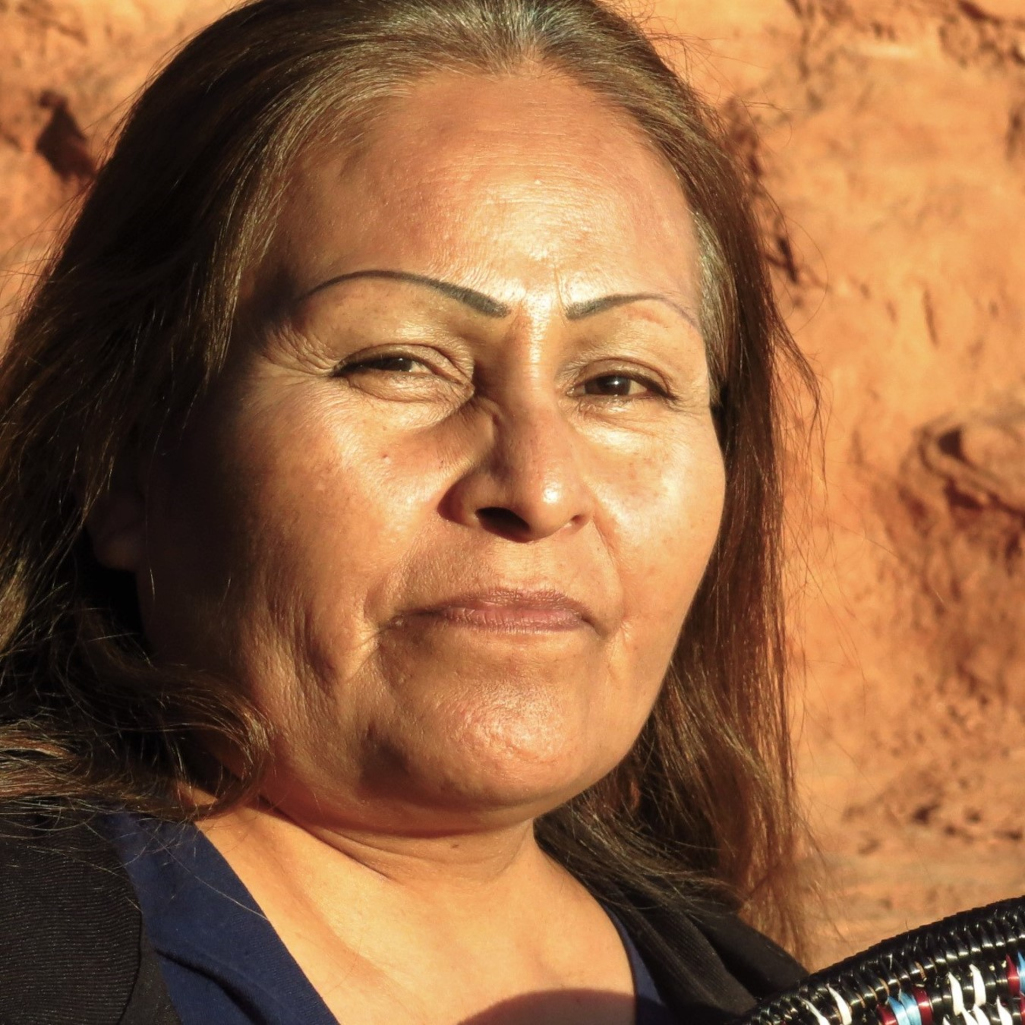
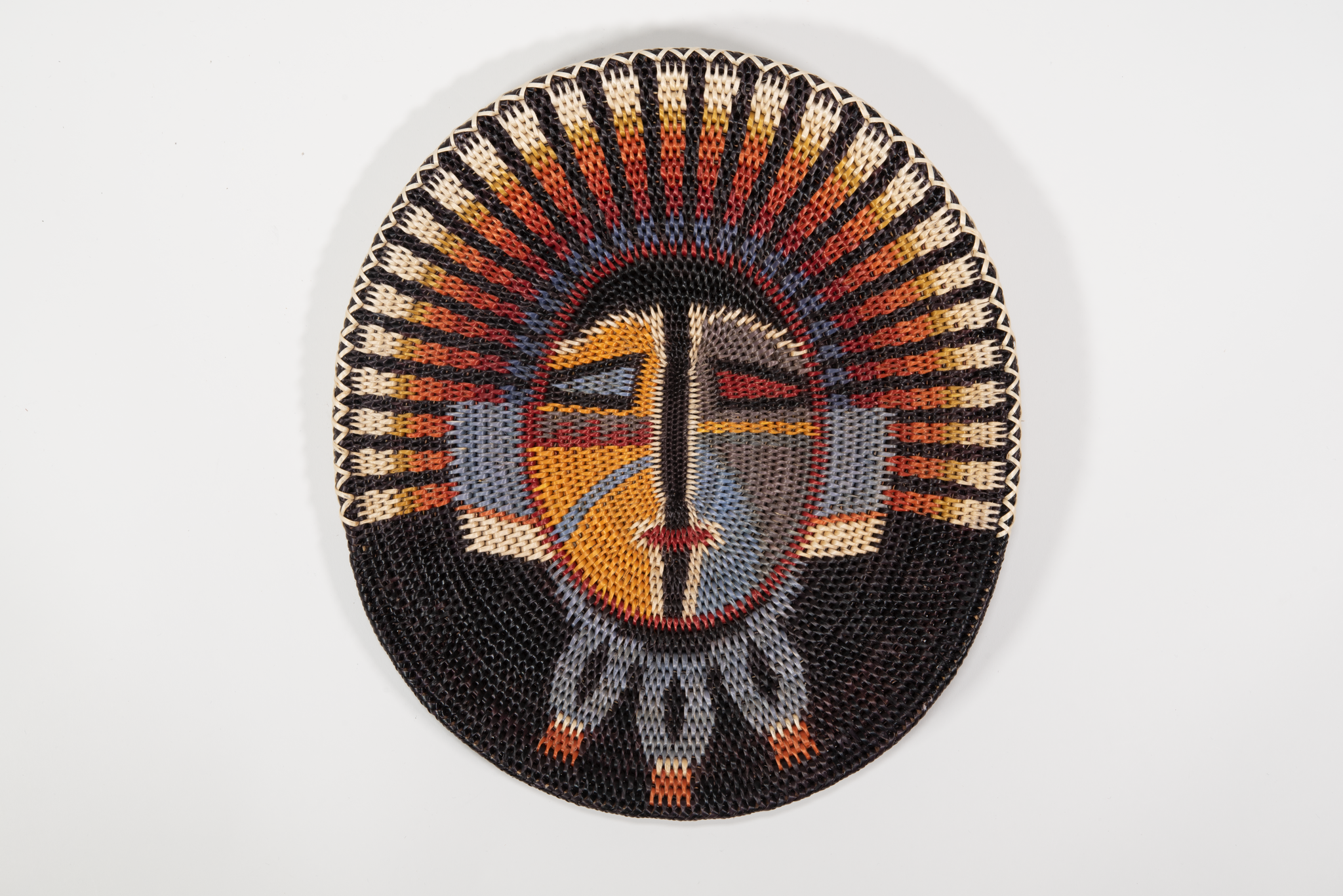
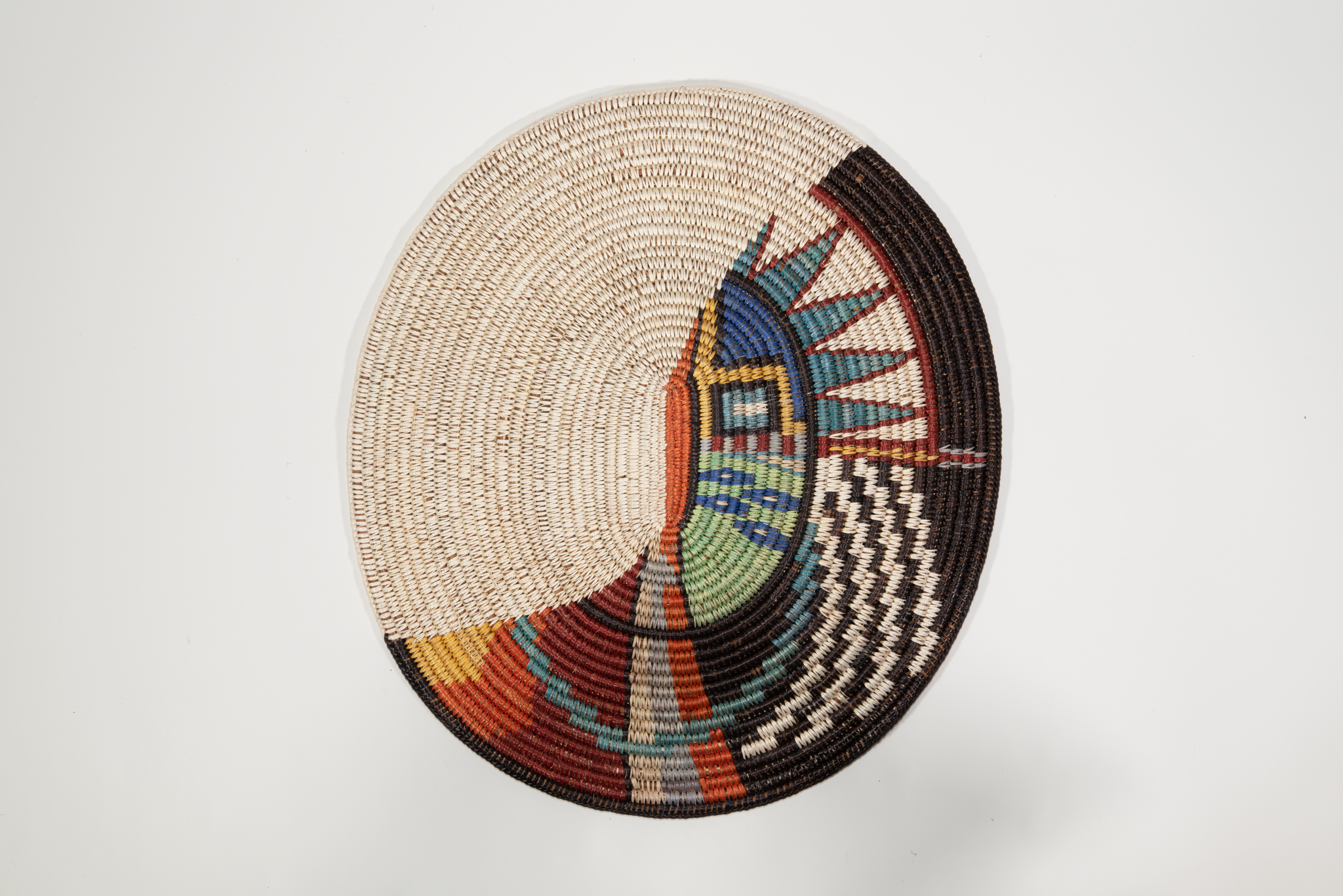
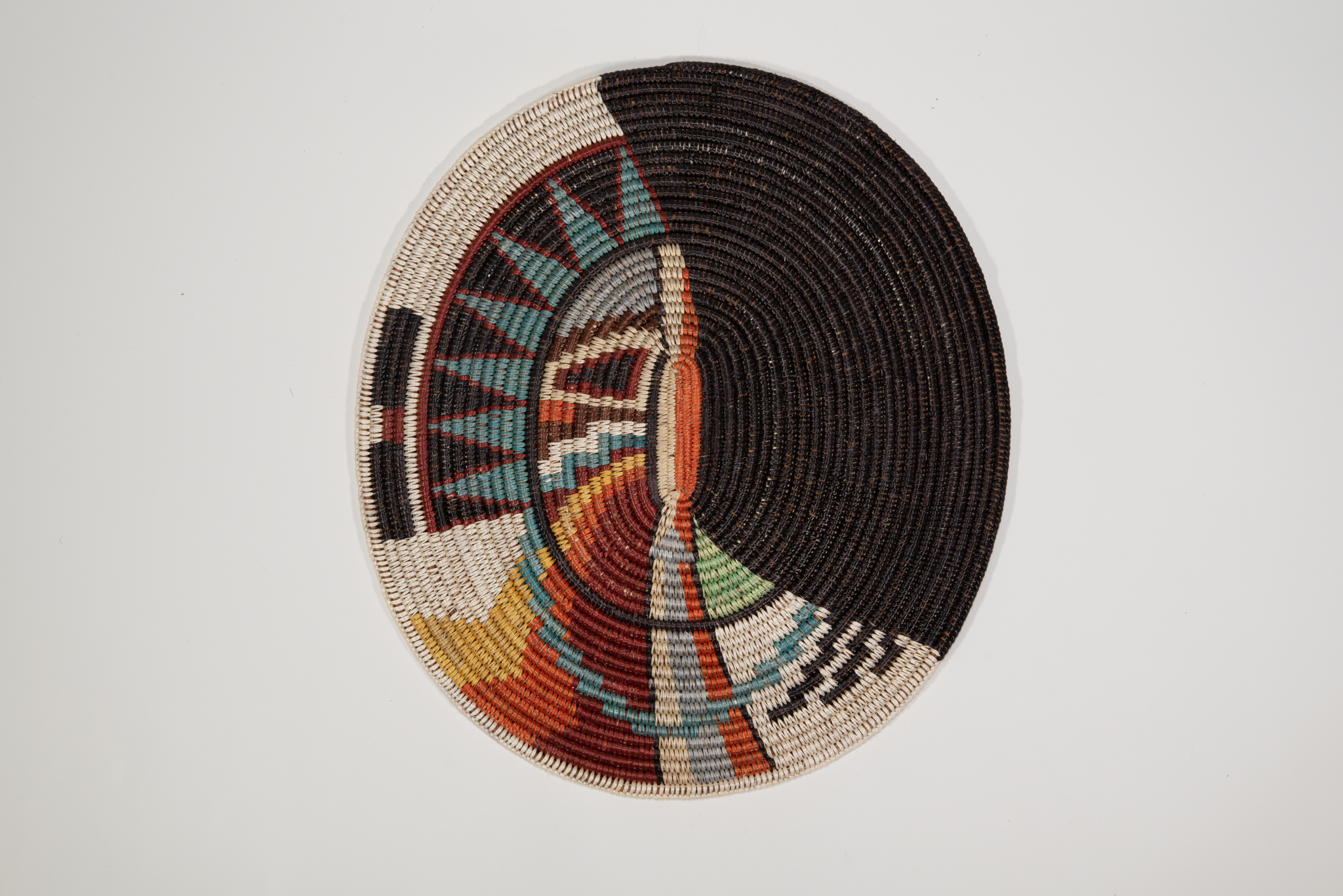
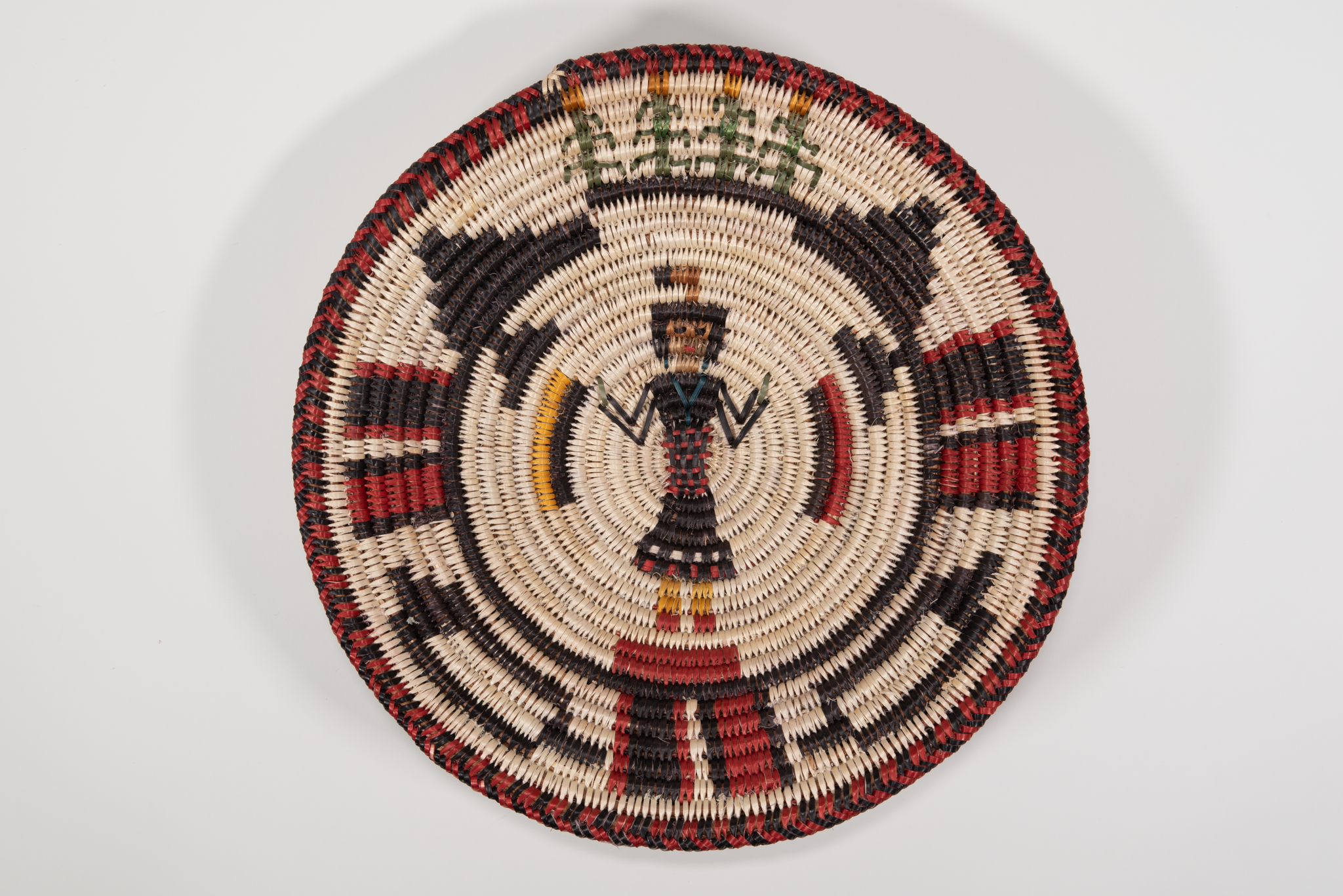
Considered by collectors and museum professionals as one of the best Navajo basket weavers, Elsie Stone Holiday has been weaving for about 25 years, since her six children became old enough to allow her time. She learned from such renowned artists as Mary, Sally and Lorraine Black, Rose Esplain, and her mother-in-law, Betty White Holiday. Then she made the art her own by using her natural, intuitive creativity. To make her baskets, she weaves sumac strips gathered from along the waterways of Utah and New Mexico.